

What Animals Are Found In The Nc Swamp
Wildlife: Mammals
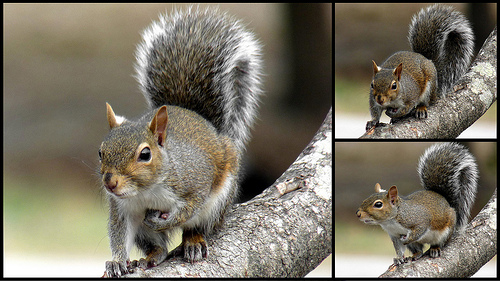
Run across: All wild animals entries; Wild animals overview; Beaver; Black Bear; Bobcat; Northern Flight Squirrel; Cougar; Coyote; Flim-flam Squirrel; Gray Fox; Grey Squirrel; Mink; Muskrat; Raccoon; Cerise Fob; Crimson Wolf; Southern Flying Squirrel; Striped Skunk; White-tailed Deer; Wild Boar
Wildlife profiles by region: Coastal Plain; Piedmont; Mountains; Vegetation past region
 Native to Due north Carolina, white-tailed deer are an integral part of the state'southward history and modern culture, beingness "every homo'southward big game animal." The male deer (buck) has long been a symbol of ability and speed, and the female (doe) figures prominently in aboriginal legends every bit the embodiment of grace and beauty. Native Americans depended on the white-tail for meat and a number of important artifacts. European settlers continued this tradition of harvesting deer for survival articles; from famous residents such as Daniel Boone to the most obscure, frontier men and women wore "buckskins." White settlers as well opened a commercial trade in deer hides for internal and overseas ventures.
Partially due to strict regulation of hunting, elimination of wild predators, and increased cultivation of food, the white-tailed population has recovered from earlier declines to achieve an all-time high. North Carolina's herd is estimated at between 1.5-2 million, approximately x percent of the national total. In many areas deer numbers take risen along with human evolution to the point that many residents are calling for increased hunting seasons and college bag limits.
Two species of wildcats live in N Carolina. The cougar or mountain lion-a large, unspotted cat with tawny-colored fur and a long tail-though non widespread, is occasionally seen in the southern Appalachian Mountains and the coastal swamps, possibly due more to the releasing of pet cougars than to whatsoever significant wild population. The bobcat is the only short-tailed cat indigenous to the mid-Atlantic region. Smaller and having a spotted glaze, this lonely and secretive hunter of rodents and rabbits appears in most parts of the land.
The black bear (Ursus americanus) is the only species of bear found in North Carolina. Information technology originated in North America and is the virtually adjustable member of the acquit family with a very wide range. In Northward Carolina, black bears are found from the Coastal Plain into the Appalachian Mountains, with the greatest concentration in the Bang-up Smoky Mountains National Park region along the North Carolina-Tennessee border. While some North Carolina counties still allow the hunting of bears, it is estimated that during the 1990s about i-third of the bears killed in southern Appalachia were taken illegally and oftentimes sold to Asian markets.
Between 1900 and 1920 red wolves were extirpated from virtually of the eastern portion of their range, including North Carolina, and by 1980 they were determined to be extinct in the wild. The cherry wolf was starting time reintroduced in the U.s.a. in 1987, when iv pairs were released into Dare County's 120,000-acre Alligator River National Wildlife Refuge. Additional releases were fabricated, and the starting time reproduction in the wild occurred in 1988. By the late 1990s there were approximately fifty reddish wolves living in the Alligator River refuge and nearby Pocosin Lakes National Wildlife Refuge. These wolves help control North Carolina's exploding white-tailed deer populations, also keeping them healthy by preying on the weak and ensuring that simply the stronger animals survive to reproduce.
All 16 species of bats found in Due north Carolina eat insects, from mosquitoes and moths to beetles, crickets, and flies. Even the smallest species swallow a lot of insects; some experts believe that a healthy bat colony, rather than annihilation manmade, is the best way to go along the mosquito population downwards. Some bats also eat crop-destroying pests. As the public has become more than aware of the helpful nature of bats, measures accept been started to preserve their numbers. At Chimney Rock Park, several caves in which bats roost take been permanently closed to the public. Bat boxes (artificial roosts) are becoming a common sight in some neighborhoods around the country.
Twenty-nine species of whales are known to inhabit the coastal waters of N Carolina. They are divided into two groups: the order Mysticeti, or baleen whales, and the order Odontoceti, or toothed whales. Baleen whales are distinguished past the big strips of whalebone, or baleen, that hang downwardly from their upper jaws, which they use to eat. Six species of baleen whales frequent the state'south littoral waters: the minke whale, Bryde'south whale, sei whale, fin whale, black right whale, and humpback whale.
Toothed whales have teeth instead of baleen in their mouths and one accident pigsty equally opposed to the baleen'southward two. Because of their teeth, members of the order Odontoceti are able to prey upon much larger marine animals than the baleen whales tin can. Toothed whales institute in North Carolina waters include the imitation killer whale, killer whale, long-finned airplane pilot whale, short-finned pilot whale, melon-headed whale, goose-beaked whale, True's beaked whale, dense-beaked whale, Gervais' beaked whale, dwarf sperm whale, pygmy sperm whale, and sperm whale. Dolphins and porpoises are too considered to be toothed whales. Species found off Northward Carolina include the harbor porpoise, bridled spotted dolphin, Atlantic spotted dolphin, striped dolphin, Atlantic white-sided dolphin, saddle-backed dolphin, and bottle-nosed dolphin.
North Carolina has many other thriving mammals, including rabbits, raccoons, opossums, beavers, and chipmunks. Foxes, both ruby-red and gray, live throughout the state. Wild boars (Squealer), not present in the U.s.a. before 1890, were introduced into North Carolina at Hooper's Baldheaded in Graham County in 1912, when George Moore of the Whiting Manufacturing Company imported 14 boars from Frg and Russia to join other exotic animals on a large, fenced tract he intended to develop as a game preserve. By the early on 1920s, the population had multiplied and many boars had escaped from the preserve; over the next quarter-century wild boars became well established in modern-day Nantahala National Forest and its environs.
Maybe the most unusual mammal in North Carolina is the flying squirrel. A web of thin, hirsuite skin on both sides of the torso extending from the foreleg to the hindleg permits information technology to perform acrobatic feats. Although the flying squirrel is yet fairly common in the land, it is rarely seen because it is nocturnal, resting past day and foraging for food, principally nuts and seed, by night.
Learn more nearly Due north Carolina'southward:
References:
Jim Dean and Lawrence Due south. Earley, eds., Wildlife in Due north Carolina (1987).
Doug Elliott, "Bats Aren't So Bad," Wild fauna in North Carolina 54 (November 1990).
John A. Fussell III, A Birder'due south Guide to Littoral Northward Carolina (1994).
David S. Lee and James F. Parnell, Endangered, Threatened, and Rare Animal of Northward Carolina (1990).
Margaret Martin, A Long Look at Nature (2001).
William Thou. Palmer and Alvin L. Braswell, Reptiles of N Carolina (1995).
Eloise F. Potter, James F. Parnell, and Robert P. Teulings, Birds of the Carolinas (1980).
Fred C. Rohde and others, Freshwater Fishes of the Carolinas, Virginia, Maryland, and Delaware (1994).
William D. Webster, James F. Parnell, and Walter C. Biggs Jr., Mammals of the Carolinas, Virginia, and Maryland (1985).
Epitome credits:
Sanderson, Virginia. 2011. "Squirrel triptych." Online at https://www.flickr.com/photos/vsanderson/5327618836/. Accessed 04/25/2012.
1 Jan 2006 | Templeton, Lee Plummer; Await, Douglas A.
Source: https://www.ncpedia.org/wildlife/mammals
Posted by: sabalagole1969.blogspot.com
0 Response to "What Animals Are Found In The Nc Swamp"
Post a Comment